
AI-Powered Animated Explainer Videos and Brand Mascots for Banking and SaaS, in Every Language
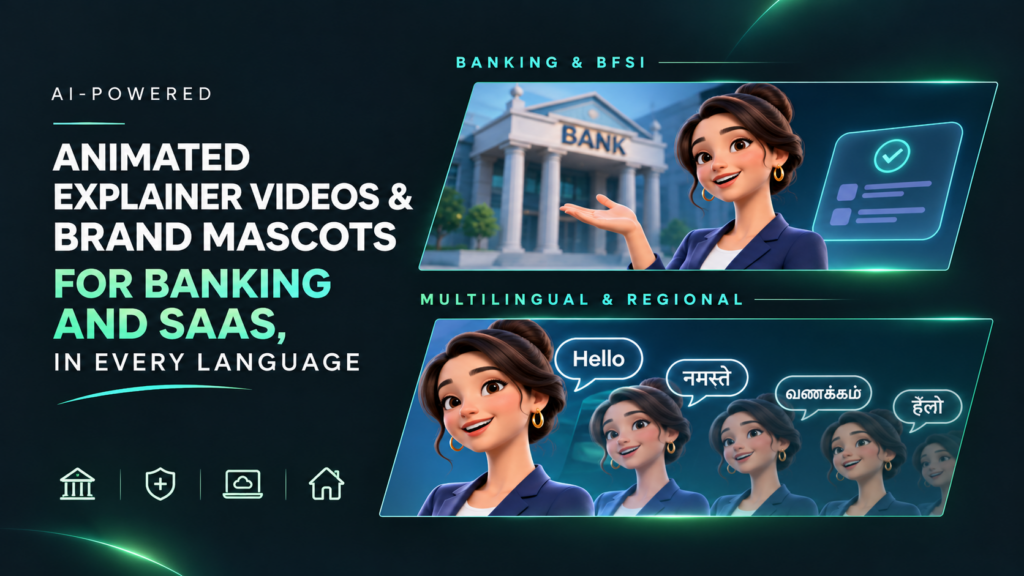
Nobody wants to read a twelve-page brochure to understand a banking product, and nobody’s finishing a forty-slide deck before they’ve decided whether to trust a new financial platform. That’s exactly why animated explainer videos have become one of the most effective formats in banking, financial services, and SaaS specifically, industries where the product itself is often genuinely complex, and where trust has to be earned before a customer or a prospect will even engage with the details.
The same need shows up just as strongly in insurance, healthcare platforms, and real estate or mortgage services, anywhere a customer is being asked to understand something layered and unfamiliar before making a decision that matters to them. An animated character walking someone through a product in ninety seconds does what a brochure, a slide deck, or a wall of website copy never quite manages: it gets watched all the way through, and it gets remembered.
One Mascot, Built for a Global Enterprise Audience
We built exactly this for Citibank in the US market, an animated character explaining an enterprise solution end to end, in a way that made a genuinely complex offering easy to follow without losing any of its substance. The real value of a piece like this isn’t just that it’s pleasant to watch, it’s how many places it can live at once. The same video becomes a sales enablement tool a distribution team can send directly to a prospect instead of a static deck. It sits embedded on the website for anyone doing their own research. It lives on YouTube for organic discovery. One production, used everywhere a prospect might actually encounter the brand.
The Same Character, Word-Perfect Across Every Regional Language
For HDFC Bank in India, we took the same underlying idea further: the identical animated character, explaining the identical product, but recreated across multiple regional languages with full dubbing, lip sync, and emotional delivery matched to each one, not a flat, robotic voiceover swap. To actually demonstrate this rather than just claim it, we built the video as a single continuous edit that cycles through languages every few seconds while the story keeps moving forward, so a viewer can watch the same character shift between languages in real time, with the emotion and delivery landing correctly in every single one, without a visible seam anywhere in the transition.
Why Animated Mascots Never Became as Common as They Should Have
The value of a recognizable animated brand character has never really been in question, brands have wanted this for decades. What blocked it was almost entirely economic and practical, not creative.
Cost was the first wall. Animation has historically been priced per second, which meant every additional piece of mascot content was a meaningful new expense. A character can only become a recognizable, trusted face through repetition, showing up again and again until an audience knows it. That kind of volume was simply unaffordable for most brands under a per-second animation cost structure, so mascots stayed rare, one-off pieces rather than an ongoing, recognizable presence.
Timeline was the second, and arguably worse. A single thirty-second to one-minute animated piece could realistically take weeks to produce. Anything longer, a full explainer or a presentation-style piece, could stretch into months. Add multi-language versions of that same content, each requiring its own animation and voice work under the old model, and the timeline multiplied further, often making it entirely impractical for anything beyond a single flagship language.
An AI, CGI, and animation pipeline removes both walls at once. The character gets built once, the same underlying asset generates content indefinitely without paying a new per-second cost every time, and full production, including multiple language versions with proper lip sync and emotional delivery, moves in days rather than months.
Why a Mascot Outlasts a Celebrity Endorsement
There’s a structural advantage to an animated mascot that’s easy to overlook: it never ages, never falls out of style, and carries no personal history that can turn into a brand liability. A human brand ambassador brings their own trajectory with them, their popularity can rise or fall independently of the brand, and if their personal reputation runs into trouble, that risk transfers directly onto whatever brand they represent. A mascot has none of that exposure. It’s entirely brand-owned, entirely controllable, and it doesn’t carry any legacy that isn’t the brand’s own to write.
Where This Goes Next: Permanent, AI-Built Human Brand Ambassadors
The same underlying capability doesn’t stop at 2D or 3D cartoon-style mascots. AI and VFX now make it possible to build a fully human-looking brand ambassador the same way, one with no real-world legacy, no personal scandal risk, and none of the natural aging or availability constraints of a real person. This kind of AI-built ambassador can be aged deliberately, restyled, moved into new environments, and even given a different accent, all while remaining the same consistent, brand-owned face over years, not just one campaign cycle.
The multilingual and regional adaptation principle applies here too, exactly the way it does across markets: a brand could maintain one global AI ambassador, or build regionally specific versions matched to the skin tone and cultural affinity of each market it serves, the same face carrying the brand everywhere, or a family of faces built specifically for each audience, without ever depending on a real celebrity’s schedule, price, or personal risk.
What used to be blocked by cost, timeline, and the fragility of relying on a real person is now simply a production decision, one a brand can make and revise as often as its strategy changes.