
The Ad Lied, Not the Parcel: Why Honest AI Product Advertising Matters
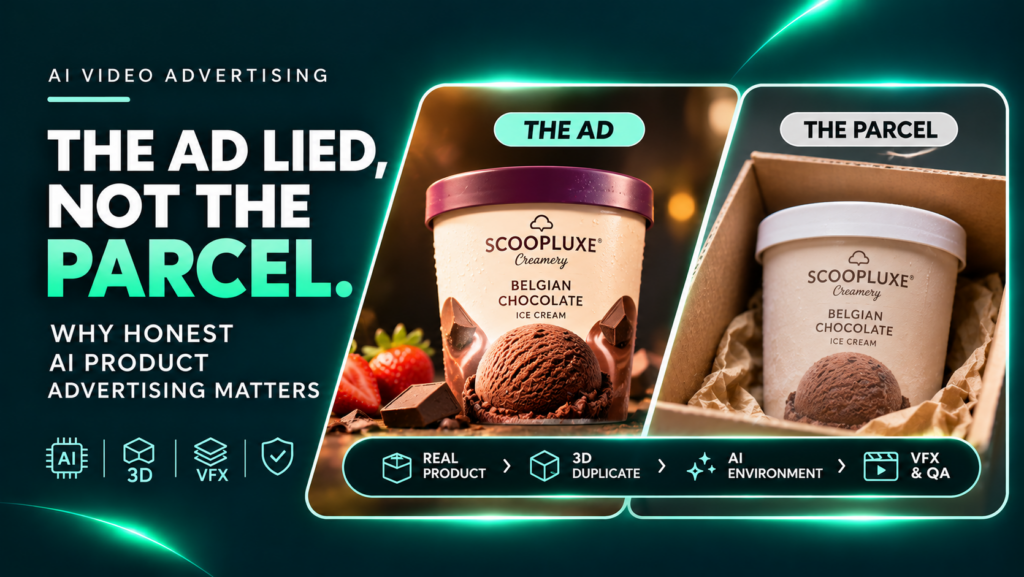
You’ve probably seen this happen.
An advertisement shows a product looking absolutely perfect. The packaging is flawless, the colours are rich, the product looks premium, and everything about the presentation makes you want to buy it.
Then your parcel arrives.
The packaging looks different. The colour isn’t quite right. The product doesn’t look anything like the version you saw in the advertisement.
And suddenly, the excitement turns into disappointment.
This is one of the biggest problems emerging in AI-generated product advertising. Not because AI cannot create beautiful advertisements, but because some brands and content creators are using it to create product representations that simply aren’t true.
The result isn’t just a bad advertisement. It’s a broken promise to the customer.
The Problem Isn’t AI. It’s What People Choose to Do With It.
AI has made it incredibly easy to create visually stunning product advertisements. A product can be placed in a luxury setting, surrounded by beautiful lighting, presented by a digital human or showcased in an environment that would otherwise require an expensive production setup.
But there’s a difference between enhancing how a product is presented and changing what the product actually is.
A skincare jar can be placed in a beautiful cinematic environment. A bottle can be showcased against an elaborate background. A food product can be presented in a visually appealing setting.
Those are creative decisions.
Changing the actual packaging, altering the product’s colour, inventing features it doesn’t have or presenting a completely different-looking product is something else entirely.
And customers notice.
The Ad Lied, Not the Parcel
Here’s where the problem becomes more serious.
When a customer receives something that looks noticeably different from what they saw in an advertisement, they don’t blame the production technique. They blame the brand.
They feel misled.
The disappointment can translate into returns, negative reviews, reduced trust and customers who may never purchase from that brand again.
And when the advertisement was created using AI, the technology often becomes the convenient scapegoat.
But was it really an AI mistake?
Sometimes, AI generation does introduce inaccuracies. Packaging details can change, logos can distort, labels can become unreadable and product proportions can shift.
However, there’s another side to this. Someone may have reviewed the output, recognised that the product wasn’t being represented accurately and still decided to publish it.
That’s not simply a technology problem. It’s a production and quality-control problem.
The pressure to create more content, faster and cheaper, should never come at the expense of consumer trust.
AI Should Change the Environment, Not the Product
This is the principle we believe should guide AI-powered product advertising.
Let AI transform everything around the product. Let it create the environment, the lighting, the atmosphere, the storytelling and even the characters presenting it.
But the product itself needs to remain accurate.
Think about what this makes possible.
A skincare product can be showcased in a premium cinematic setting without changing its packaging. A mobile phone can be placed in a futuristic environment without altering its design. A food product can be presented in a beautiful lifestyle setting while retaining its actual packaging, branding and proportions.
The creative possibilities are enormous. Product accuracy shouldn’t be the compromise.
How We Make Product Accuracy Work in AI Video Production
At V4B.ai, we approach product-led AI video production differently.
The process starts with the actual product, not an AI-generated interpretation of it.
Maintaining product accuracy requires more than a good prompt. It requires a combination of 3D modelling, CGI, AI generation, VFX and detailed post-production.
Here’s a look at how we approach the process.
1. Start With the Real Product
The client shares clear photographs of the actual product, captured using a good mobile camera or professional photography setup.
These images become the reference for the product’s packaging, shape, colours, proportions, labels and other important details.
The objective is to establish exactly what the real product looks like before beginning production.
2. Build a Verified 3D Digital Duplicate
Our in-house 3D and CGI team recreates the product using professional tools such as Autodesk Maya.
The model is carefully built, textured and colour-matched to maintain consistency with the actual product.
This creates a reliable digital duplicate that can be used across different environments, scenes and advertising formats.
3. Let AI Build the World Around It
Once the product is established, AI takes over the creative environment.
It can generate backgrounds, lifestyle settings, characters, cinematic sequences, lighting concepts and storytelling elements.
The product remains the accurate visual anchor while the surrounding world can change according to the campaign’s creative direction.
4. Check Every Frame
This is where production expertise becomes essential.
Our post-production team reviews the generated footage and replaces or corrects product elements wherever AI introduces visual inconsistencies.
Through CGI, VFX and frame-by-frame quality checks, we ensure that the final advertisement stays as close as possible to the actual product.
Because getting the first frame right isn’t enough. The product needs to remain consistent throughout the video.
This Isn’t About Making AI Look More Real. It’s About Making Advertising More Honest.
There’s a common misconception that the objective of AI video production is simply to make everything look more realistic.
We believe the objective should be bigger than that.
A visually stunning advertisement that misrepresents a product isn’t good advertising. A beautiful environment cannot compensate for inaccurate packaging. And an impressive AI-generated character cannot make a misleading product presentation acceptable.
The technology should help brands tell better stories, not create unrealistic expectations.
This is also why the combination of AI, CGI and VFX matters. Each technology has a role to play, and knowing where one should take over from another is what makes the production reliable.
What This Means for Brands Embracing AI Advertising
AI has created an opportunity for brands of every size to access production quality that was previously available mainly to companies with substantial advertising budgets.
But accessibility also brings responsibility.
Brands need to think beyond how quickly an advertisement can be generated or how much a production costs. They need to consider what the customer actually sees, what the advertisement promises and whether the product that arrives will live up to that expectation.
The future of AI-powered advertising shouldn’t be about producing the most visually impressive image at the lowest possible cost.
It should be about creating compelling advertisements that customers can trust.
At V4B.ai, our approach is simple:
Shoot the real thing. Build the world around it. Check every frame.
Because sooner or later, every product arrives.