
How to Avoid AI Slop in AI Video Advertising
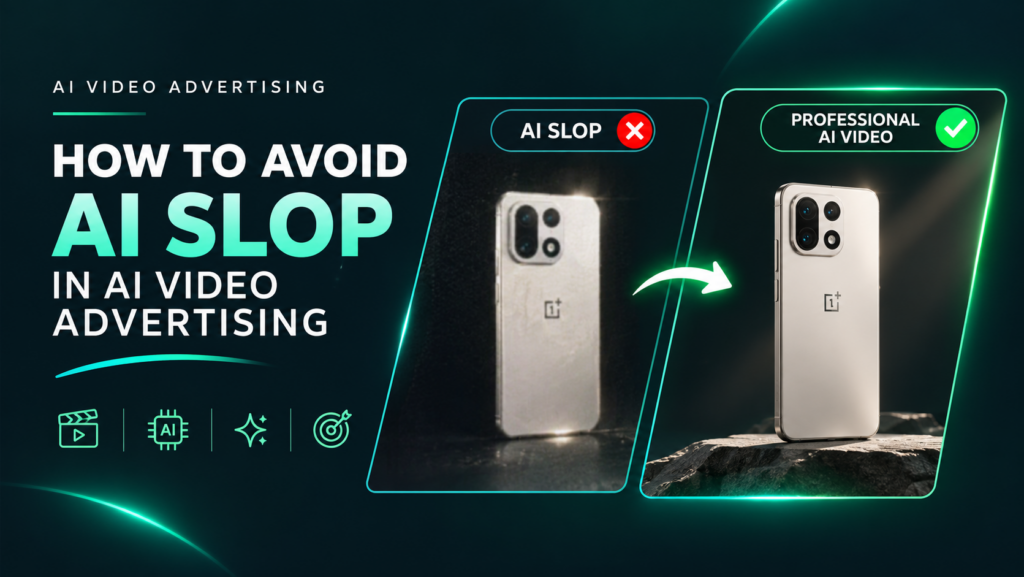
There’s a term for exactly what happens when AI-generated advertising goes wrong, and it’s not a niche complaint anymore, it’s mainstream enough that some of the world’s biggest brands have run headfirst into it. “AI slop” is what the internet started calling low-effort, hollow-feeling AI content once enough of it started showing up in places people expected real craft. Coca-Cola’s 2024 AI-generated holiday commercial drew exactly this reaction, technically competent, emotionally empty, and widely criticized for feeling soulless from a brand famous for the opposite. McDonald’s pulled an AI-generated Christmas ad entirely after a similar backlash, and Valentino faced the same response to an AI campaign that viewers said looked cheap and unsettling for a brand built on craftsmanship. These aren’t small companies experimenting carelessly. They’re brands with enormous budgets and enormous creative resources, and they still walked directly into this.
That’s the real lesson here: AI slop isn’t a beginner’s mistake you outgrow with a bigger budget. It’s what happens whenever the technology gets used without the specific craft and oversight that keeps it from showing its seams.
Why It Looks Cheap, Even When It Wasn’t
The tells are specific, and once you know them, they’re impossible to unsee. Humans that move slightly wrong, skin and expression that read as plastic rather than real. Dialogue that doesn’t land naturally, lip sync that’s a beat off from the words. No real score or sound design behind it, just generic or absent audio doing none of the emotional work a soundtrack is supposed to do. A story that doesn’t actually go anywhere because there was no real script or creative direction behind it, just a prompt.
None of these are AI’s fault in the way people assume. They’re the fault of using AI generation as the entire production, instead of as one layer inside a real one. A platform subscription or a freelancer without real production experience can generate a video. Neither can direct one, score one, correct one, or catch the specific places AI tends to fail before it ships.
The Pricing Trap That Makes This Worse
Here’s where a lot of brands, especially smaller and newer ones, talk themselves into the mistake. A properly built AI, CGI, and VFX production pipeline genuinely does bring cost down, roughly a tenth of what equivalent traditional production would run. That’s real, and it’s the actual economic shift behind everything in this space. But a tenth of a real production budget is not the same number as a few hundred dollars. Brands chasing that second number, effectively expecting a hundredth of the cost rather than a tenth, aren’t getting a discount on the same quality. They’re getting exactly what that price actually buys: no script writer, no director, no editor, no product accuracy pass, no sound design, all the things that were never optional, just invisible when they’re done well.
The brand damage from that isn’t hypothetical either. It’s the exact backlash Coca-Cola, McDonald’s, and Valentino all experienced, at any budget.
What the Other Side of This Actually Looks Like
The same technology, used by people who understand both its strengths and its specific failure points, produces the opposite result entirely. Scalability and cost efficiency are real strengths worth capturing. Human realism, natural dialogue delivery, and product accuracy are real limitations that have to be actively engineered around, not hoped away.
This is genuinely what took real investment to solve, not a subscription tool switched on overnight. Getting to a production pipeline that reliably avoids every one of the tells above took close to a million dollars in dedicated development across roughly two years, real trial and error, real specialists, real failures worked through before arriving at something dependable. No single AI platform is strong at everything, the actual skill is knowing which platform’s strengths to draw on for which part of a project, and having the CGI, VFX, and post-production team in place to correct exactly where any of them fall short. Done properly, the output shouldn’t be identifiable as AI-made at all, not because it’s hiding anything, but because every one of the usual tells has already been caught and corrected before it ever reaches a viewer.
What This Looks Like Across Real Categories
The point of showing this many categories side by side isn’t variety for its own sake. It’s that none of them read as AI-made, and that’s the actual bar. The technology didn’t change what’s possible. The craft around it decides whether a brand ends up in the Coca-Cola and McDonald’s story, or in this one.