
How to Make AI Avatars Sound Natural: Why the Script Isn’t the Performance
For as long as brands have used AI avatars, creating a video has usually meant one thing: paste in a script, pick a voice, and press generate. The same tone for a product launch, a policy update or a customer apology. The words get delivered exactly as written, but very little of the meaning gets delivered with them.
That shortcut was never a creative choice. It was simply what the tools were built to reward. Most AI avatar platforms were designed to turn text into a talking head as quickly as possible. The primary input was always the script, while directing a performance, the way a director works with an actor on set, was rarely part of the workflow.
The result? Dialogue that sounds robotic, expressions that feel disconnected from the message, and videos that viewers instinctively scroll past.
Here’s what most people miss about natural dialogue delivery: it’s never just about the words. A good actor can say the same line a dozen different ways, curious, confident, guarded or amused, and each version communicates something entirely different.
What determines which version you get isn’t the script. It’s what the performer understands about the scene before saying a single word.
What Natural AI Avatar Dialogue Actually Looks Like: One Person, Three Avatars, One Line
We created a short film to demonstrate exactly this.
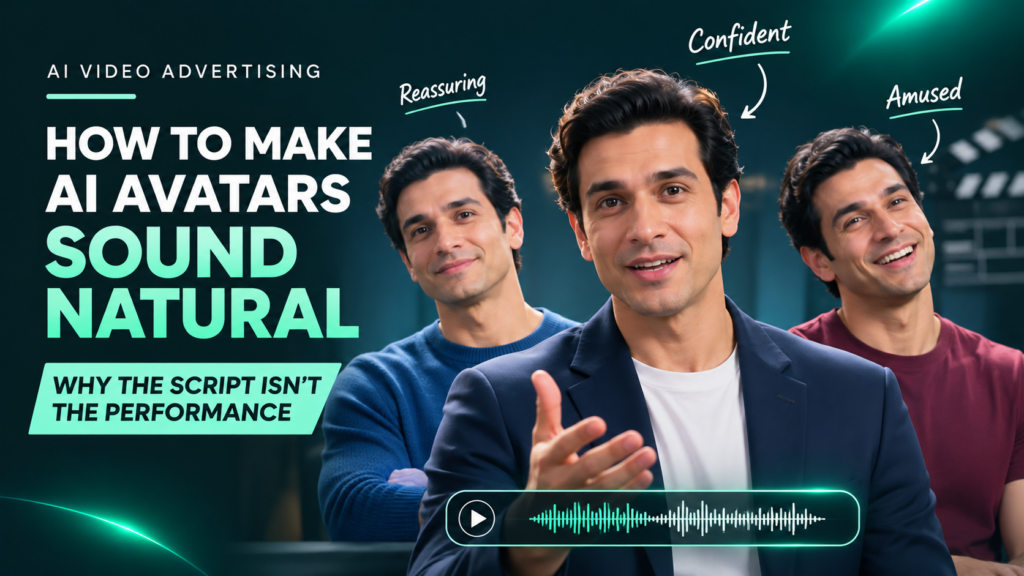
It opens in a large, well-lit film studio with the same man appearing three times: seated in a director’s chair wearing a navy blazer, standing in a blue sweater, and standing again in a maroon T-shirt.
All three are AI avatars of the same person. All three deliver the exact same line. Yet each delivers it as a completely different performance.
Watch the demonstration:
The method behind it is simple to explain, but takes real creative understanding to execute well: give the AI the intention before giving it the dialogue.
Before the model ever sees the line, it needs to understand what that line is supposed to achieve.
That means answering four important questions:
The Four Questions Behind Every Natural AI Avatar Performance
- What is the intention?
Is the character trying to reassure, persuade, warn, invite or inform? The intention determines how the dialogue should be delivered.
- Who are they speaking to?
A first-time customer, a board member and a nervous borrower all require different communication styles. Understanding the audience changes the delivery.
- What do they want from the conversation?
Are they trying to build trust, encourage a sign-up, influence a decision or simply make someone smile? The desired outcome shapes the performance.
- What are they hiding?
This is the question most AI avatar workflows overlook, and arguably the most important one.
A salesperson who is quietly unsure of the numbers, a founder who is more excited than they’re letting on, or a bank officer who knows the customer won’t like the answer will all communicate differently.
The unspoken layer changes how every word lands.
Give the intention first and the dialogue second, and the same sentence stops being a string of words. It becomes a moment in a scene.
That’s how one line in our film turns into three distinct performances.
The Economics of AI Avatar Video Production: From a Simple Room to a Cinematic Studio
Here’s the second half of the film, and the part that usually surprises people.
Midway through, the video cuts to the original source footage: the same person sitting on an ordinary chair in the corner of an office, in front of a grey cloth pinned to the wall.
No studio. No elaborate lighting rig. No camera crew.
Everything the audience saw in the first half, the studio floor, the lighting, the cinematic framing and the overall environment, was created afterwards using AI, CGI and VFX.
Traditionally, achieving footage that looks like this would mean booking a studio, dressing the set, arranging lighting, hiring a crew and planning separate setups for every wardrobe change and performance.
If a line didn’t land the way the brand wanted, correcting it could mean arranging another shoot day.
With an AI, CGI and VFX production pipeline, the presenter can record once in a controlled environment. The virtual set, lighting and cinematic surroundings are designed afterwards. If the dialogue doesn’t feel right, the performance can be redirected without rebuilding the entire production setup.
No additional studio rental. No second set. No additional crew day for every variation.
The order matters, though. The set and lighting come after the performance, not instead of it.
A beautiful virtual studio cannot rescue a flat delivery. That’s why creative direction comes first.
AI Avatar Videos Across Industries: The Same Direction, Different Performances
The four questions remain the same across industries. The answers change, and those answers determine how the avatar communicates.
Here’s the same performance-direction approach across four categories we produce content for.
Beauty
Banking and Financial Services (BFSI)
FMCG
Fitness and Wellness
The same principle extends across languages and markets.
A directed performance combined with proper regional adaptation means the delivery is rethought for each audience, not simply re-voiced in another language.
A line that should sound warm and reassuring in one market, for example, might need a more direct and matter-of-fact delivery in another.
This is closely connected to what we explored in our article on why dubbing isn’t adaptation.
Why Professionally Directed AI Avatar Videos Don’t Sound Like AI Ads
The difference between a robotic AI avatar and a convincing digital presenter comes down to production discipline.
Someone still needs to write the intention, understand the audience, decide what the character is holding back, review the generated performance and recognise when a delivery isn’t quite right.
Sometimes the direction is as simple as: make it more guarded, sound less certain, or deliver the line with more warmth.
That’s creative direction, and it’s the part of the process that cannot simply be handed over to a model.
This is also why professional AI video production requires more than access to an avatar-generation platform.
Most avatar platforms give brands a tool and leave the performance entirely to whoever types the script. The result is often a talking head rather than a directed spokesperson.
At V4B.ai, we bring performance direction, AI avatars, voice technology, CGI, VFX and post-production together within one production pipeline. This allows the creative vision to remain consistent, from the first line of dialogue to the final frame, while reducing the coordination required between multiple production vendors.
The same approach works for UGC-style videos, performance ads, product explainers, corporate communication and brand films.
A presenter who sounds like they genuinely mean what they’re saying is just as important in a fifteen-second social media ad as in a longer brand film.
And that’s the difference between generating an AI avatar video and actually producing one.
The Future of AI Avatar Videos Is About Performance, Not Just Realism
AI avatar technology is becoming increasingly accessible. Creating a digital presenter, generating a voice and producing a talking-head video are no longer the difficult parts.
The real differentiator is what happens around those capabilities.
Brands don’t just need digital faces that can speak. They need digital presenters who can communicate with the right emotion, understand the context of a message and deliver it in a way that connects with the intended audience.
AI provides the scalability. Creative direction provides the performance.
At V4B.ai, we combine both to create AI-powered brand communication that goes beyond simply putting words on screen.